
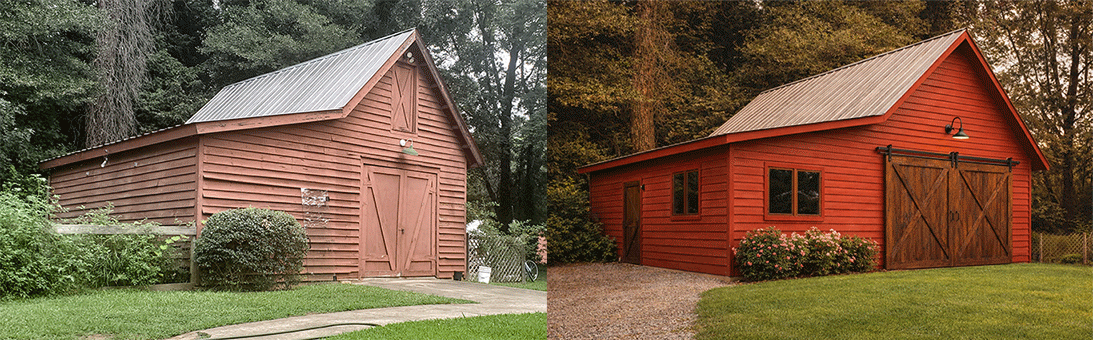
The Barn Project
The Story
The client is an 82-year-old widower currently living in a 3-story, 4,000 square foot house on six acres. It’s time to move closer to family. His son has a barn on his property. Not big, but big enough. It’s not too old and still has good bones, so let’s make it new, and amazing! We all want to thrive in our final years, but if our home is unhealthy, uncomfortable and costly to live in, we have missed the mark. This barn, this home, will be designed and built to create an environment for life…and life to the full! Let’s see how it’s done.
In The Beginning
This barn wasn’t originally built for occupancy. Leaky. Damp. Moldy. It was for storage and mechanics. We had a long way to got. But first, approval was needed from the city council and the planning and zoning committee. The necessary variances and condition use permits were acquired by the client and the project was underway. The structure was constructed with a thick slab, but no footers, so that was task number one. It’s a timber frame structure, which means the 12 vertical posts carry all of the load. Under each was added copious amounts of concrete. Now, we were ready for demolition!
Demolition
Down to the bones, and then some. The siding came off. The sheathing underneath came off. At this point, the barn began to reveal some of the casualties of 33 years without adequate projection. Some old termite damage. Some carpenter bees. A lot of wood warped beyond usability. Quite a bit of mold. The plan was to leave as much of the bones a possible, but less remained at the end than we’d hoped. But we can rebuild! It’s what we do.
Water! We need water!
Due to the exorbitant cost of tapping the city sewer and water, the client opted to connect to his son’s main water and sewer lines at the primary residence. Our fantastic grading and pipe contractor ensured those new connections were tight and the sewer lines ran downhill (very important!). The plumber followed right behind excavating the thick slab of the barn to lay the drain lines exactly where we needed them.
Make it tight
All homes leak air. They used to be intentionally designed to leak air, but this was based on a faulty understanding of what makes a structure last, and last comfortably. The simple explanation: Houses will naturally develop a low pressure relative to the outside air pressure. So they suck air. If we haven’t intentionally designed from where they suck, they’ll do so from the grossest places possible, such as around your ceiling registers where cockroaches poop. Instead, let’s build a house that is super air tight with a ventilation system that gives the client FULL control over where their fresh air comes from - like the great outdoors. This is a healthy home from day one.
Comfy Concrete
As mentioned, the barn was not built for a person. It was built for tools and storage. So that thick slab just sits directly on the dirt. Not vapor barrier. That means when the ground gets wet, the concrete gets wet. Without a solution, that damp concrete would lead to an uncomfortable and likely moldy environment. Let build this scientifically! Since we can’t add a barrier under existing concrete, lets add a dimple mat. This allows vapor pressure above and below the slab to equalize, completely eliminating the force that pushes moisture into your home (its called vapor drive, by the way). Since we’re down there, let’s insulate! One inch of rigid foam insulation should keep that floor friendly to the feet. But now we need a substrate we can attach to, so let’s do two layers of perpendicular 3/4” subfloor. Why two layers? Because the first layer floats on the insulation and the second layer screws to the first holding it all together. Now you have a dry, insulated, cushy floor, ready for hardwoods, that’ll last a lifetime, and then some.
First world conveniences
This client decided he wanted indoor plumbing and electricity, so we at Charash Renovations provided. Our spectacular subcontractors always hit the mark and exceed in installation quality. Other trades often comment, “Who did your plumbing/electrical? It’s so neat!” Neat work comes from intentionality. Businesses love to say, “We focus on the details”. The proof is in the pudding, folks, and the pudding here is top notch. We are constantly amazed at the devotion to well-done work by our subs. That’s why we chose them. That’s why we keep them.
Healthy, Comfortable & Efficient
If a tightly built structure is the skin & bones, then the heating, air condition and ventilation (AKA HVAC) are the organs that determine if you are just surviving or thriving. An intentionally designed system with components curated for the space leads to full control of the air around you. Hot spots, cold spots, polluted air, moldy air. If we build a leaky house and just install a basic HVAC unit, we’ll likely have all of these, and more. In the barn, we chose a high-efficiency Trane, a device called an Energy Recovery Ventilator (ERV) and a whole-house dehumidifier.
Love that hat!
The typical roof: Roof decking over a vented (HOT) attic. A layer of synthetic felt to keep it dry(ish). Topped with a layer of heavy, black fossil fuel (ASA asphalt shingles) that’ll last 10-20 years if that felt doesn’t leak first. The barn shall not suffer under such a burden. This client opted for a multi-layered roof system that will keep it well insulated, perfectly dry and last 50 or more years. We start with a weather-resistive barrier, followed by two layers (3 1/2”) of rigid insulation. We topped that with a fresh layer of roof decking, now we get synthetic felt and finish it off with metal roof which also serves as a radiant barrier. Heat and moisture are arch enemies to most building materials. We took care of those bad guys so this roof will last a very long time.
A warm jacket
When you go outside in the winter, do you stuff fluffy stuff between your ribs? Of course not! That wouldn’t keep you warm at all (and it would hurt)! You put on a jacket. So why don’t we do that with our buildings? Well, thoughtful builders do. A few inches of rigid insulation on the exterior side of your walls not only makes a huge difference in the wall efficiency but does so without elevating the risk of mold inside your walls. Adding insulation to your wall cavities slows down heat transfer. This is a good thing until it prevents your sheathing from drying out, resulting in a populated mold colony quietly plotting a takeover.